


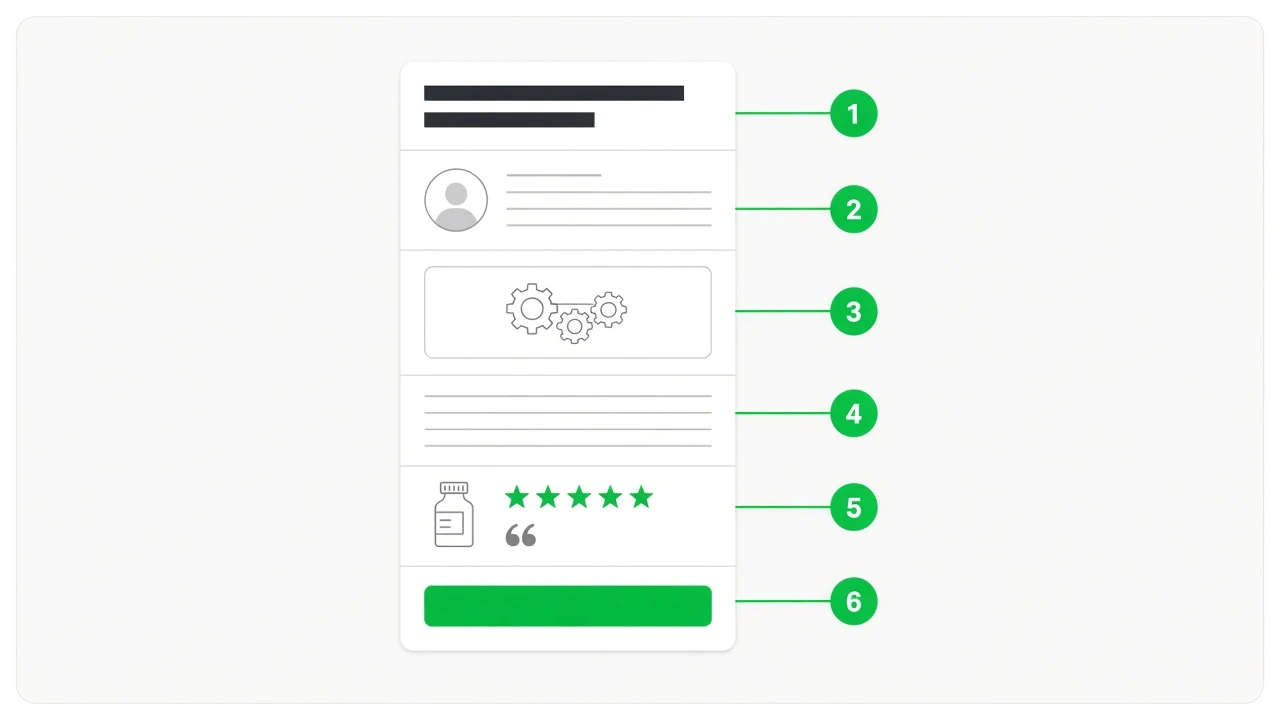
Most guides on how to write an advertorial stop at "make it look editorial". That is a design note, not a funnel.
An advertorial has one job in a paid funnel: take a cold reader who does not yet know what is wrong, and move them one rung up the awareness ladder. Then the product page does not have to diagnose and close at the same time. Write for that job, and the rest (length, byline, images, offer) falls into place.
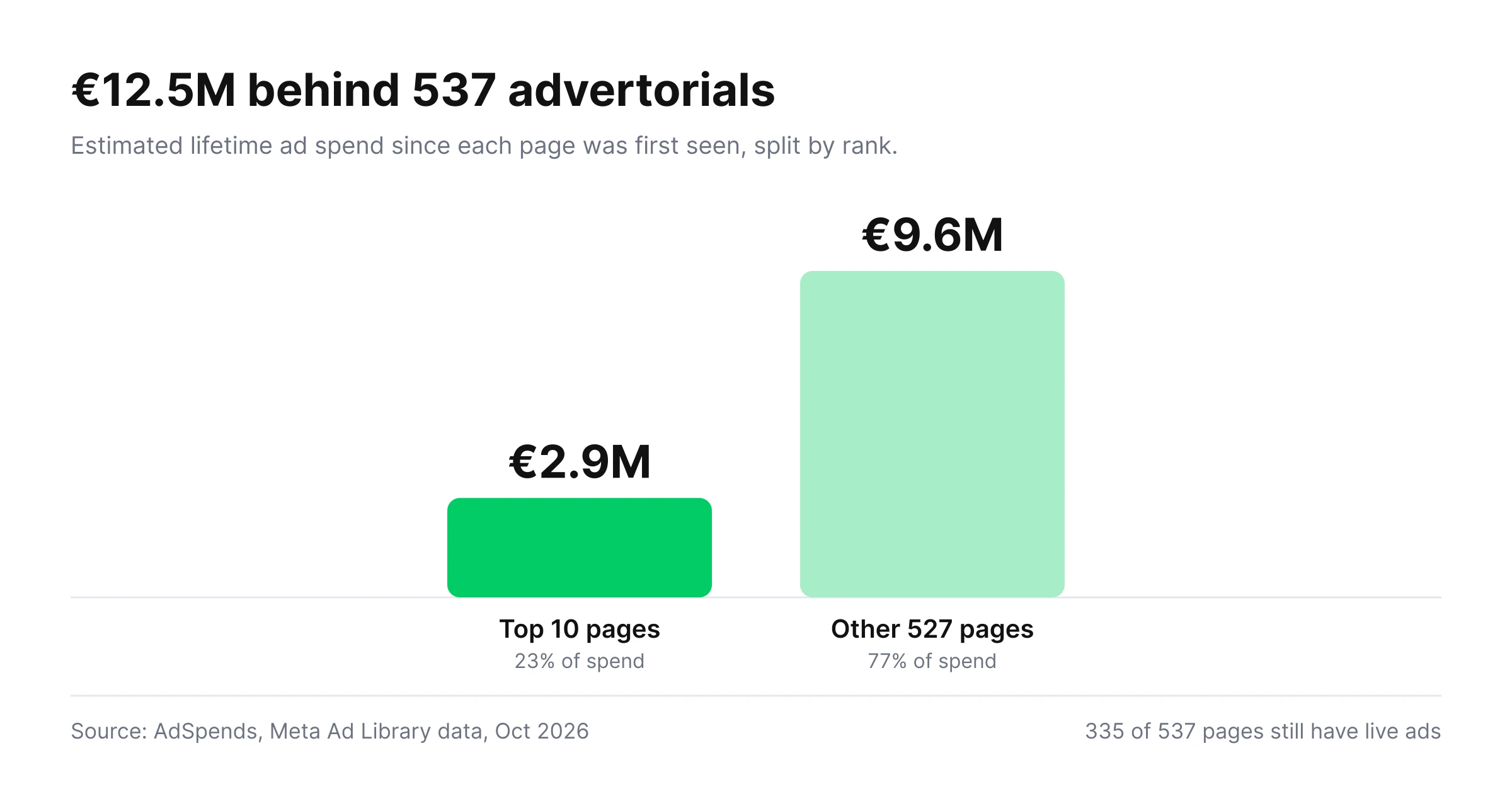
This guide is built on what is actually running: 537 advertorial landing pages from 199 brands, €12.5M in estimated ad spend, 335 still live, and a median page running 127 days. Every structural claim below traces back to one of those figures.
TL;DR: An advertorial sits between the ad and the product page: the ad earns the click, the advertorial qualifies the reader, the product page closes. Write it in six beats: hook, problem block, mechanism, pivot, product and proof, offer and CTA. Hidden Root Cause shows up on 66% of the 537 live advertorials, Failed Alternatives on 64%, testimonials on 83% and a money-back guarantee on 66%. The median page runs 127 days. The "$100K a day" in the title is a standard, not a measurement: AdSpends spend figures are lifetime estimates, never a daily budget.
What an advertorial is, and the three ways writers get it wrong
In short
- An advertorial is a paid page dressed as editorial, selling one product.
- Its job is to move a reader one awareness stage, not to close the sale.
- If the story survives with the brand name deleted, it is an advertorial. If it dies, it was a sales page in a costume.
The working definition: a landing page bought with paid distribution, written and laid out like a story, a news article or a first-person account (byline, date, sources, quotes), carrying one product and one call to action.
The reader arrives from an ad. They did not search for you, subscribe to you, or ask for the email. That is what separates an advertorial from a blog post.
Three ways writers get it wrong, all of them visible in the data:
- The swap-the-headline sales page. Feature stack, brand voice, "we" and "our". The reader clocks it in two lines and leaves.
- Content with no commercial job. A readable article that never names a mechanism and never asks for the click. Traffic without a next step.
- Mystery with no payoff. A promised secret, eight hundred words of delay, nothing testable at the end.
Who these pages are written for is measurable. Of the 537 classified pages, 53% land at solution-aware and 35% at problem-aware. Only 12% are product-aware. The market writes for readers who already know the problem exists and that solutions exist. It rarely writes for readers who know neither.
Where the advertorial sits in the funnel: creative, advertorial, PDP
In short
- The creative earns the click: one hook, one promise, one image.
- The advertorial qualifies: it diagnoses the problem and names a mechanism.
- The PDP (product detail page) closes: price, bundle, guarantee, cart.
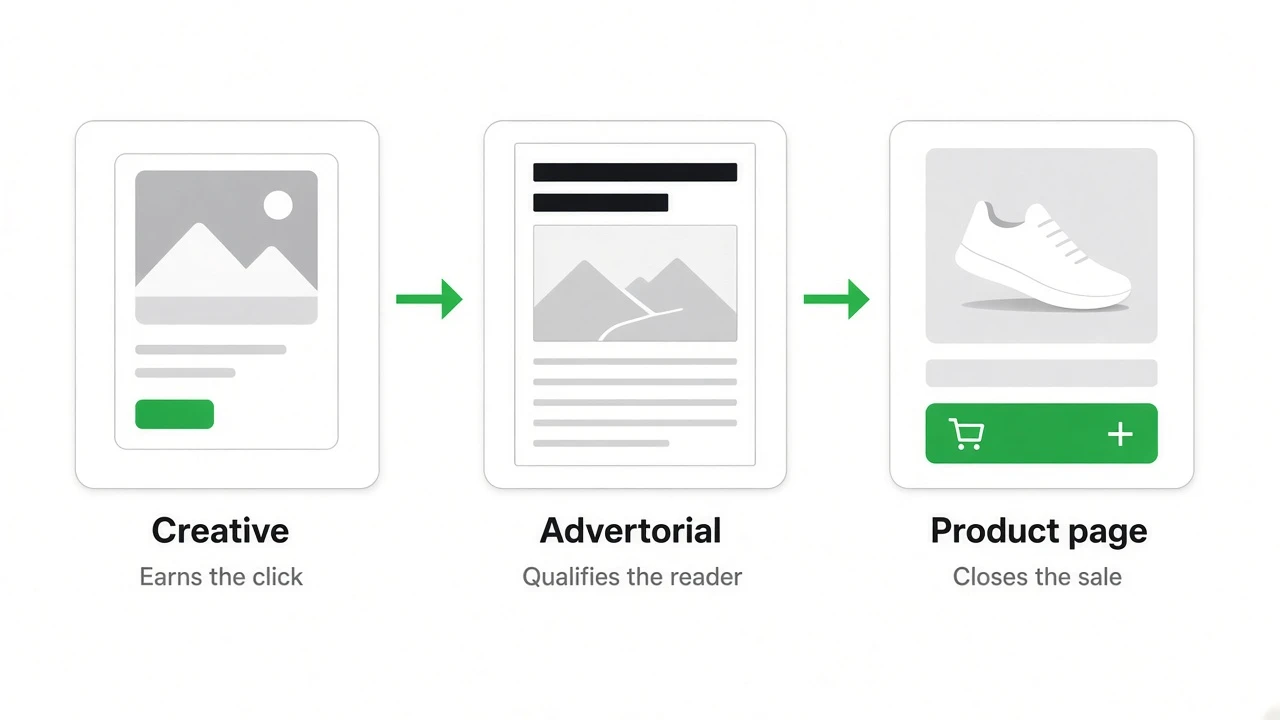
Three assets, three jobs, three metrics. Hook rate belongs to the creative. Mechanism reach and click-through belong to the advertorial. Conversion rate and AOV belong to the PDP.
The product page converts badly. Isn’t that a product page problem?
Often not. When a brand blames the product page for a bad advertorial, it is usually reading the wrong metric.
The handoff rule is simple: the last line of the advertorial and the first line of the PDP must make the same claim in different words. The mechanism name must appear verbatim on both pages.
The ads do half of this work already. In the top-spend page of the set, the ad copy carries the mechanism into the feed (a technique that "uses audio frequencies to trigger a neurological shift"), so the page can open on the problem instead of re-introducing the product.
1
433€
14.5K
0
Health Insider
359dThis simple technique uses audio frequencies to trigger a neurological shift – reducing tension, calming racing thoughts, and improving focus. No meds, no side effects, no meditation skills. Most users report a noticeable difference in under 7 minutes. READ MORE –> https://health
 healthinsider.news
2
277€
9.24K
0Health Insider
359dThis simple technique uses audio frequencies to trigger a neurological shift – reducing tension, calming racing thoughts, and improving focus. No meds, no side effects, no meditation skills. Most users report a noticeable difference in under 7 minutes. READ MORE –> https://health
 healthinsider.news
3
203€
6.79K
0Health Insider
361dThis simple technique uses audio frequencies to trigger a neurological shift – reducing tension, calming racing thoughts, and improving focus. No meds, no side effects, no meditation skills. Most users report a noticeable difference in under 7 minutes. READ MORE –> https://health
 healthinsider.news
That is how a Hidden Root Cause angle, used on 66% of pages, survives cold traffic: the reframe starts in the ad, lands on the page, and closes on the PDP.
Cold traffic arrives unaware: the ladder your advertorial has to climb
In short
- Cold Meta traffic is unaware or problem-aware. Almost never more.
- One asset, one rung. The advertorial adds a stage; the PDP adds the next.
- Copy written for a most-aware reader converts nobody in a cold feed.
Eugene Schwartz set out the five stages in Breakthrough Advertising (1966): unaware, problem-aware, solution-aware, product-aware, most-aware. The less aware the reader, the more context the copy has to carry. The more aware, the more directly it can sell. That single sentence decides the length of your page.
Map the six beats onto the ladder:
- Beats 1–2 (hook, problem block) take an unaware reader to problem-aware. They must recognise themselves before they will read a mechanism.
- Beats 3–4 (mechanism, pivot) take a problem-aware reader to solution-aware. This is the step most print guides skip entirely.
- Beats 5–6 (product, proof, offer) take a solution-aware reader to product-aware, then hand them to the PDP to finish the sale.
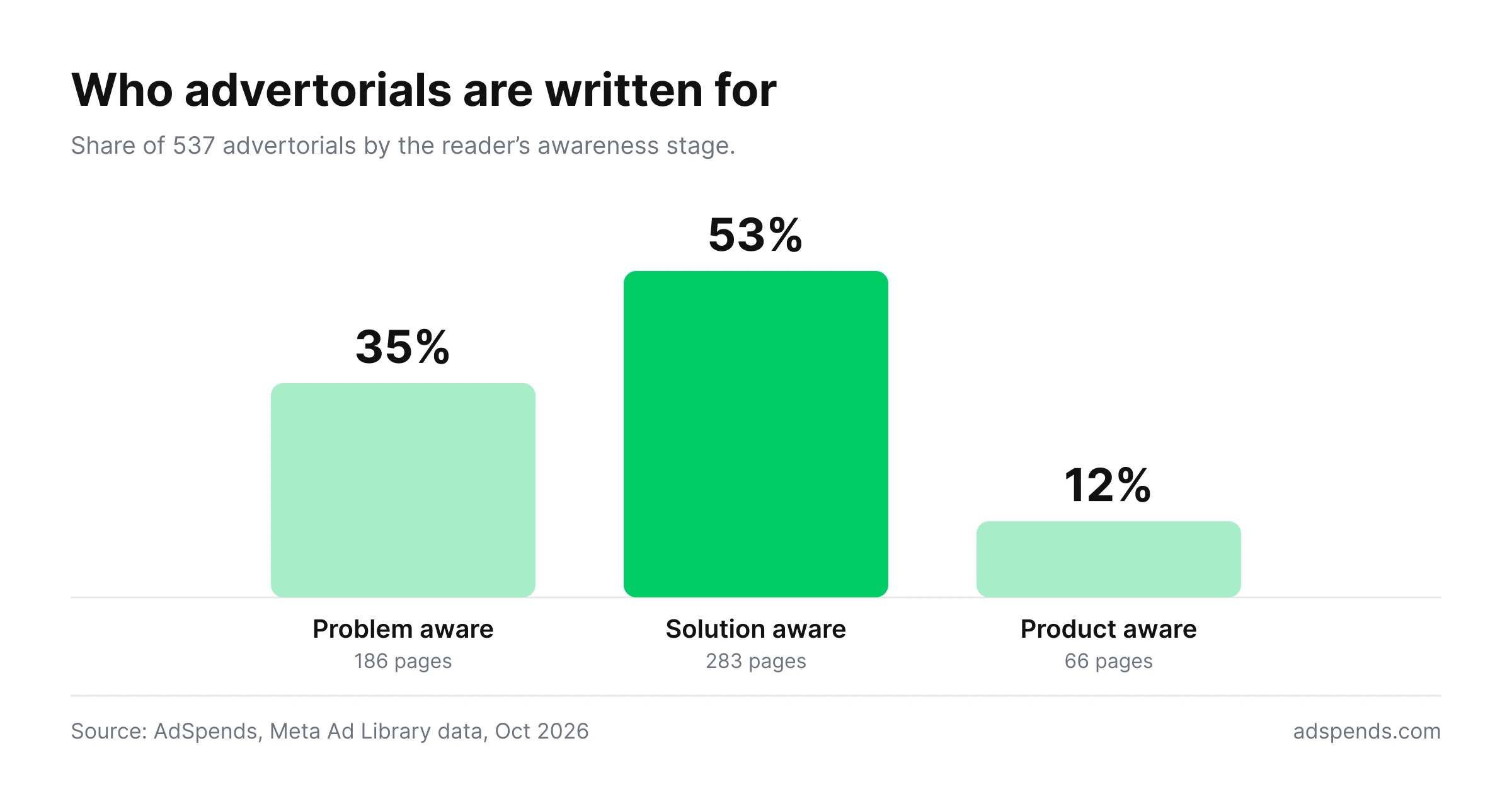
The product-aware minority is where the comparison pages live: the supplement that lines up against AG1 with clinical-trial percentages and a free welcome kit. If your ad is cold, that is not your page.
See the full table: awareness stage of the 537 advertorials
| Awareness stage | Share of advertorials | Pages | All English direct-response pages |
|---|---|---|---|
| Solution aware | 53% | 283 | 53% |
| Problem aware | 35% | 186 | 34% |
| Product aware | 12% | 66 | 12% |
AdSpends dataset, October 2026. Baseline: all 559 English direct-response pages in the same dataset.
Start with the money: what advertorials are actually spending right now
In short
- 537 advertorial landing pages from 199 brands.
- €12.5M in estimated lifetime spend behind them.
- 335 pages still have active ads, and the median has run 127 days.
Here is the whole set, as of October 2026:
| What the dataset measures | Figure |
|---|---|
| Advertorial landing pages | 537 |
| Brands | 199 |
| Estimated ad spend, since each page was first seen | €12.5M |
| Pages with active ads | 335 |
| Median days running | 127 |
| Top 10 pages, share of spend | €2.9M (23%) |
| New advertorial pages in the last 30 days | 35 |
| Pages with a stated price point | 94 low, 53 mid, 8 high |
See the full table: the 10 advertorials with the most estimated spend
| # | Brand | Domain | Format | Awareness | Est. spend | Ads | Days running |
|---|---|---|---|---|---|---|---|
| 1 | Health Insider | healthinsider.news | Story Advertorial | Solution aware | €617.5K | 1,931 | 396 |
| 2 | Alicia Smith | news.mullend.com | Story Advertorial | Problem aware | €338.4K | 1,081 | 81 |
| 3 | IM8 Health | im8health.com | Story Advertorial | Product aware | €307.0K | 238 | 484 |
| 4 | Purdy & Figg | purdyandfigg.com | Story Advertorial | Solution aware | €280.1K | 16 | 208 |
| 5 | Prevalnt | prevalnt.com | Story Advertorial | Solution aware | €274.3K | 45 | 209 |
| 6 | Your Pet Nutrition | caninehealthsecrets.com | Expert Advertorial | Problem aware | €269.5K | 368 | 143 |
| 7 | Bettervits | campaigns.bettervits.co.uk | Story Advertorial | Solution aware | €223.2K | 438 | 255 |
| 8 | Serenithy | serenithy.com | Story Advertorial | Problem aware | €208.2K | 928 | 436 |
| 9 | Body & Bra | bodyandbra.com | Story Advertorial | Problem aware | €198.7K | 196 | 59 |
| 10 | Koprez | offers.koprez.com | Story Advertorial | Solution aware | €198.0K | 47 | 108 |
AdSpends dataset, October 2026. Estimated spend since each page was first seen.
That is why the title’s $100K-a-day bar has to be read as a standard. The data cannot confirm a daily budget for any page. It can confirm survival: the top page in the set has carried €617.5K in estimated spend across 1,931 ads over 396 days. Pages that lose money do not stay in the library that long.
Read the full ranking in 537 live advertorial examples, ranked by estimated spend.
The six structural pieces, in order
In short
- Six beats, in reading order: hook, problem, mechanism, pivot, product, CTA.
- Each beat moves exactly one awareness stage.
- The same skeleton is the advertorial template you reuse per angle, per avatar, per niche.
This is the answer to how to write an advertorial that survives paid traffic. Six beats, one job each:
- Hook. A named person, a number, a stake, in the first 40 words.
- Problem block. The problem restated in the reader’s own words, plus the failed alternatives they have already paid for.
- Mechanism. The named reason this works when the others did not.
- Pivot. From mechanism to solution category: this class of solution, and here is why the class works.
- Product and proof. The one product inside that category, with testimonials, counts, ratings and citations.
- Offer and CTA. One discount, one risk reversal, one reason to act now.
Nobody has to guess whether the order matters. Every live page that carries spend can be checked against the skeleton, ad by ad, in the Meta Ad Library brand profiles: 800,000+ brands, every ad linked to the landing page it sends traffic to.
Pieces 1 and 2: the hook and the problem block
In short
- The hook names one person, one number, one stake in 40 words.
- The problem block names the cost of doing nothing, in the reader’s words.
- Then it lists four to six alternatives they already tried, and why each failed.
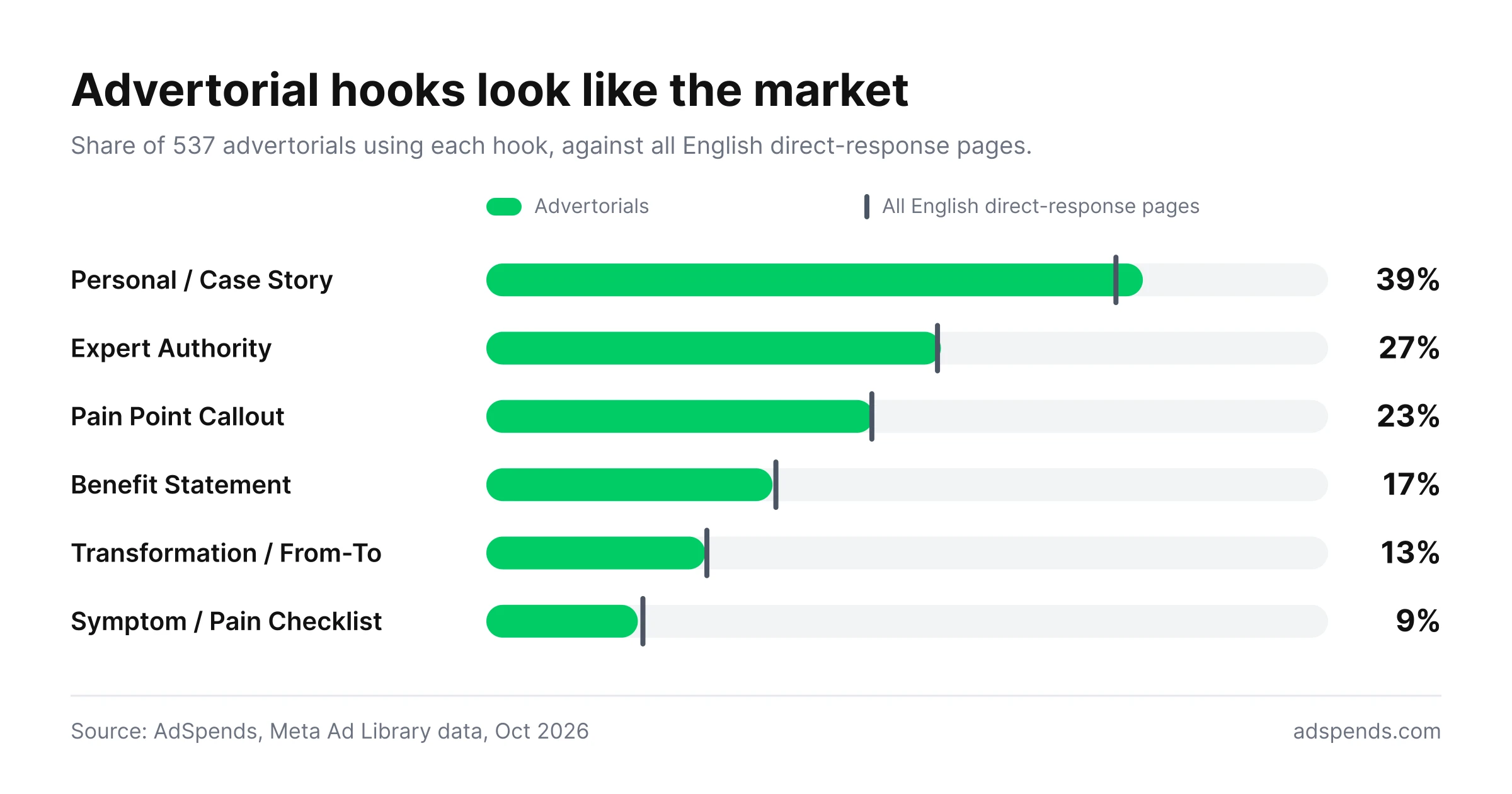
See the full table: hooks across the 537 advertorials
| Hook | Share of advertorials | Pages | All English direct-response pages |
|---|---|---|---|
| Personal / Case Story | 39% | 208 | 37% |
| Expert Authority | 27% | 146 | 27% |
| Pain Point Callout | 23% | 124 | 23% |
| Benefit Statement | 17% | 92 | 17% |
| Transformation / From-To | 13% | 72 | 13% |
| Symptom / Pain Checklist | 9% | 51 | 9% |
AdSpends dataset, October 2026. Baseline: all 559 English direct-response pages in the same dataset.
Personal story leads, but only two points above the market baseline. The hook is not where advertorials differentiate. The angles underneath it are.
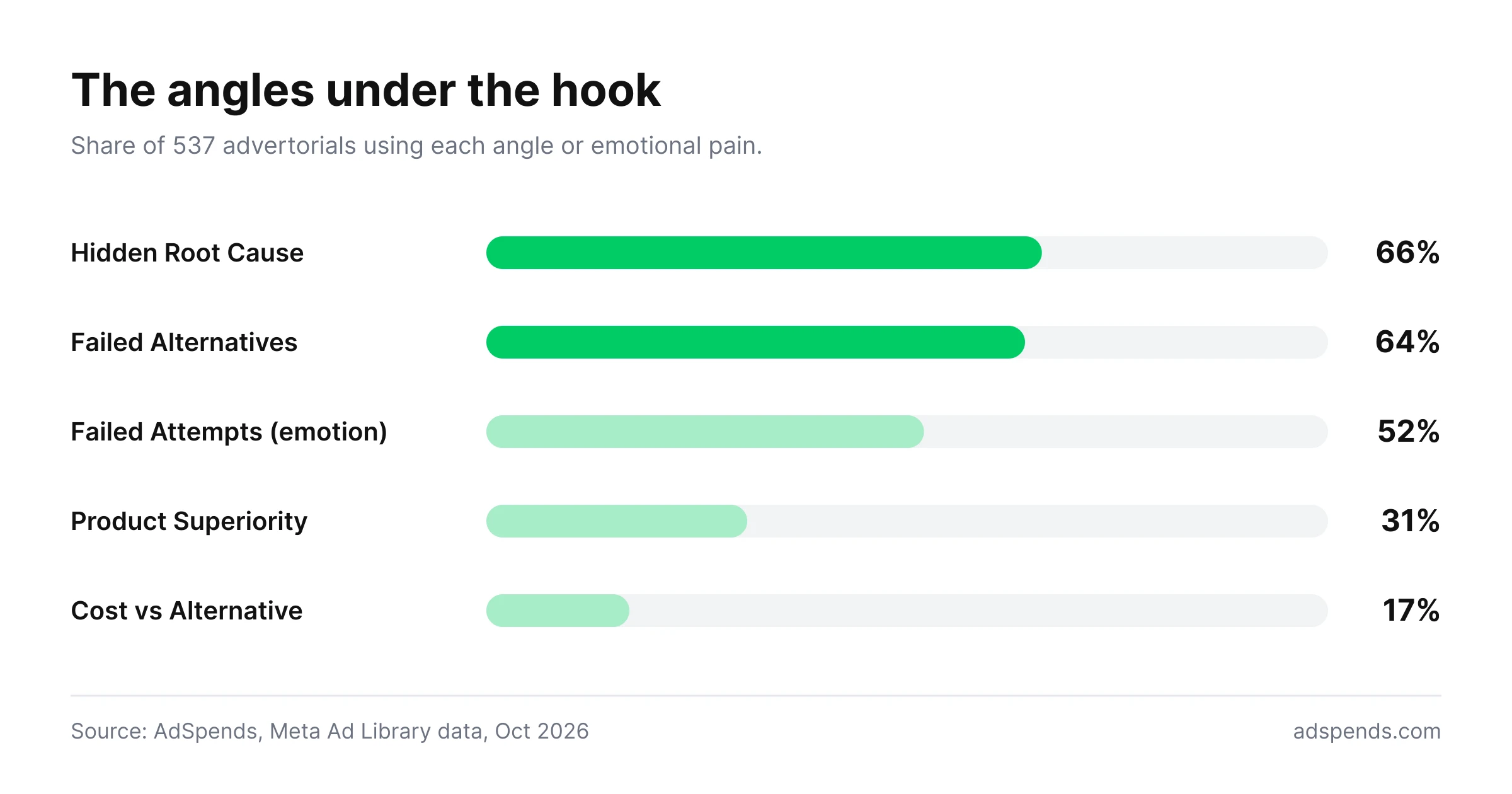
See the full table: angles across the 537 advertorials
| Angle | Share of advertorials | Pages | All English direct-response pages |
|---|---|---|---|
| Hidden Root Cause | 66% | 356 | 66% |
| Failed Alternatives | 64% | 344 | 63% |
| Product Superiority | 31% | 164 | 31% |
| Cost vs Alternative | 17% | 92 | 17% |
| Drug-Free Alternative | 17% | 89 | 17% |
| Natural vs Chemical | 13% | 69 | 13% |
AdSpends dataset, October 2026. Baseline: all 559 English direct-response pages in the same dataset.
See the full table: emotional pains and pain points
| Emotional pain or pain point | Share of advertorials | Pages | All English direct-response pages |
|---|---|---|---|
| Failed Attempts (emotional) | 52% | 278 | 51% |
| Wasted Money & Overpaying (emotional) | 20% | 107 | 19% |
| Shame About Appearance (emotional) | 14% | 74 | 14% |
| Missing Out on Life (emotional) | 10% | 56 | 10% |
| Fear of Worsening (emotional) | 10% | 55 | 10% |
| Frustration (emotional) | 8% | 42 | 8% |
| Fatigue & Low Energy | 26% | 141 | 26% |
| Sleep Problems | 23% | 123 | 23% |
| Weight Gain & Weight-Loss Resistance | 15% | 82 | 15% |
| Bloating | 11% | 60 | 11% |
| Mobility Limitations | 11% | 58 | 11% |
| Stress, Anxiety & Mood | 10% | 54 | 10% |
AdSpends dataset, October 2026. Baseline: all 559 English direct-response pages in the same dataset.
That combination is the whole problem block. The reader has been told the wrong cause, has paid for solutions that missed it, and is now suspicious of every claim, including yours.
Curiosity does heavy lifting here too. The 39 pages built on a curiosity gap hook carry €1.2M between them, with 83% of that spend in the top 10. They stack the same two angles harder than the market does: Hidden Root Cause on 79% of pages, and clinical and science claims on 41% versus 24% across all English direct-response pages. Sample them in curiosity gap headline examples with the spend behind them.
Pieces 3 and 4: the mechanism and the pivot to the solution category
In short
- Name the mechanism by the 400-word mark and never rename it.
- Explain it in one paragraph a stranger could repeat back.
- Pivot to the category, then narrow to the one product inside it.
The mechanism is the beat that moves a reader from problem-aware to solution-aware. It is also the beat most guides skip, which is why their advice produces articles that read well and sell nothing.
A mechanism is not a feature and not an ingredient. It is the causal story: this is why your problem exists, this is the thing that interrupts it, this is why everything else failed to interrupt it.
The dataset is full of them, each one a sentence you could put on a slide: binaural beats for a nervous system stuck in a frequency problem, tri-therapy spinal decompression for compressed discs, a gut-vagina axis for recurring infections, a nail matrix method, a biofilm dissolving shield, a PCOS cortisol loop.
Two tests before you keep a mechanism:
- Can a reader repeat it to their partner in one sentence?
- Does it make every failed alternative look predictable rather than stupid? If the mechanism doesn’t explain the failures, it isn’t a mechanism yet. It’s a claim.
The pivot is where the category gets named. "This is not a sleeping pill, this is nervous-system regulation." Once the reader accepts the category, the product is a choice inside it rather than a pitch.
In the sleep and stress niche (53 pages, 24 brands, €2.0M, median run 118 days) that argument runs on citations.
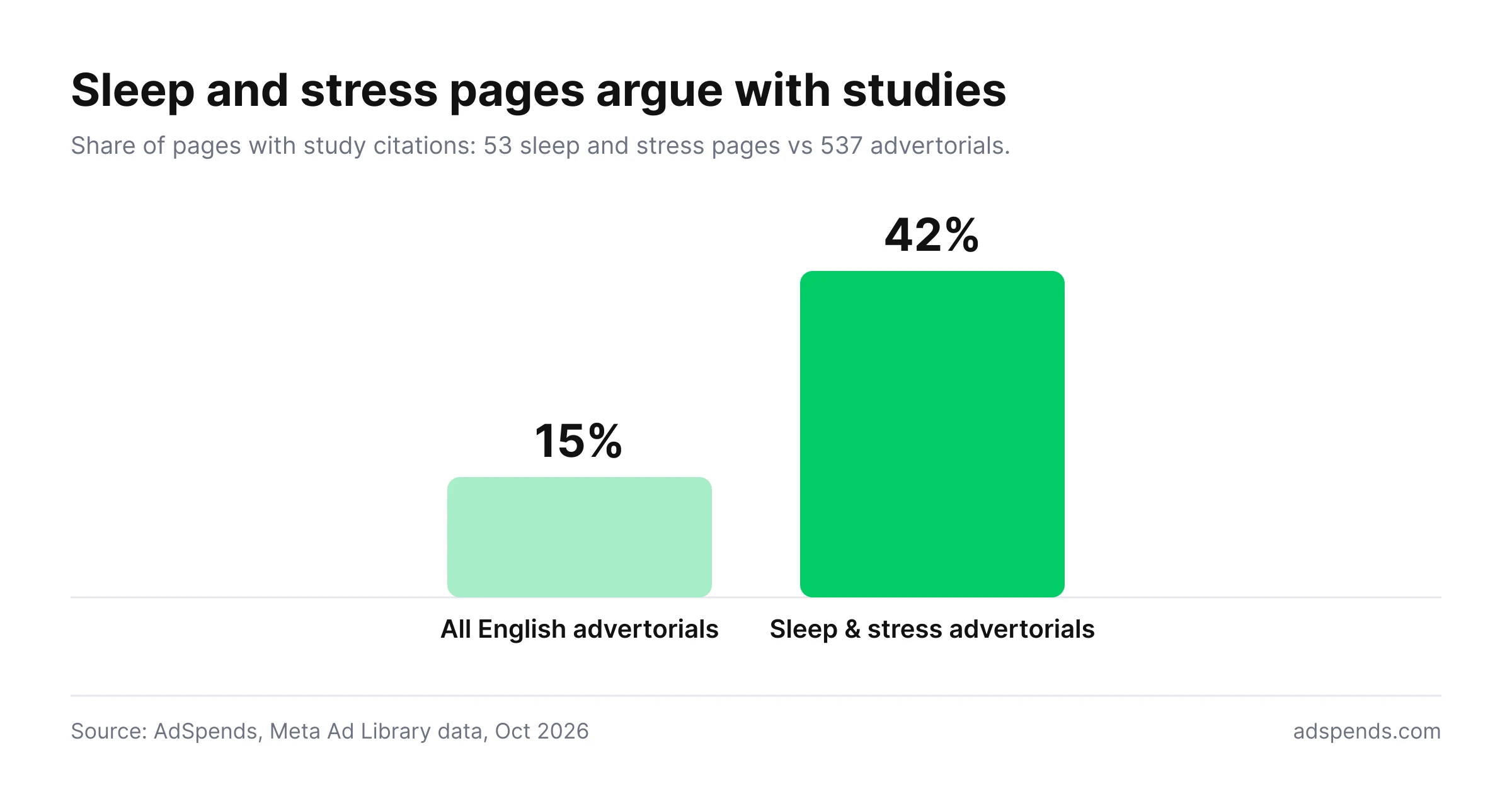
See the full table: proof on sleep and stress advertorials
| Proof element | Sleep & stress pages | Pages | All English advertorials |
|---|---|---|---|
| Customer Testimonials | 58% | 31 | 83% |
| Clinical & Science Claims | 47% | 25 | 23% |
| Customer & Sales Count | 43% | 23 | 45% |
| Study Citations | 42% | 22 | 15% |
| Stock Scarcity | 40% | 21 | 42% |
| Author Byline & Bio | 38% | 20 | 19% |
AdSpends dataset, October 2026. 53 sleep and stress advertorials vs all 537 English advertorials.
See the pattern in sleep and stress advertorials ranked by spend.
Pieces 5 and 6: the product, the proof and the CTA
In short
- One product on the page. Not a range, not a bundle wall.
- Proof that answers the reader’s objection, not proof that praises the product.
- One discount, one guarantee, one reason to act now.
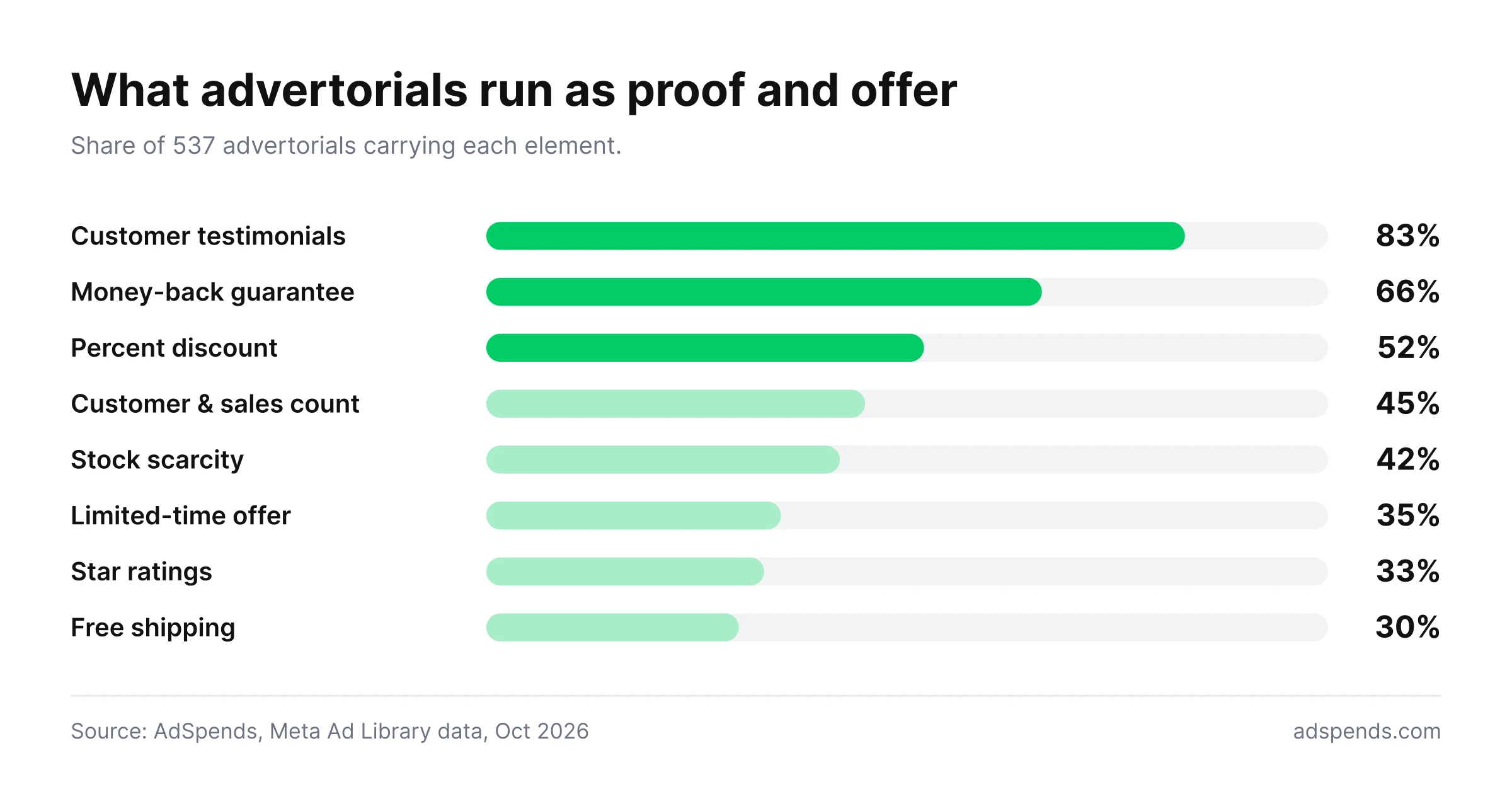
See the full table: every proof and offer element
| Element | Share of advertorials | Pages | All English direct-response pages |
|---|---|---|---|
| Customer Testimonials | 83% | 445 | 82% |
| Money-Back Guarantee | 66% | 357 | 67% |
| Percent Discount | 52% | 281 | 53% |
| Customer & Sales Count | 45% | 239 | 45% |
| Stock Scarcity | 42% | 223 | 41% |
| Limited-Time Offer | 35% | 190 | 35% |
| Statistic Claims | 33% | 177 | 33% |
| Star Ratings | 33% | 176 | 33% |
| Free Shipping | 30% | 162 | 31% |
| Clinical & Science Claims | 23% | 124 | 24% |
| Free Gift | 7% | 38 | 7% |
| Strikethrough Price | 7% | 36 | 7% |
AdSpends dataset, October 2026. Baseline: all 559 English direct-response pages in the same dataset.
Read that as a stack, not a menu. The default that survives:
- testimonials that name a person, a profession or a city;
- a count ("thousands", "over 100,000") to make the proof statistical;
- a guarantee that answers the "what if it doesn’t work for me" objection;
- one percent discount, framed as an editorial exclusive rather than a generic sale.
Guarantee length is the most under-copied variable in the set. Among the 376 pages tagged with a money-back guarantee, lengths in the top 10 range from 30 to 120 days: 30 for devices and consumables, 90 for supplement and skincare offers, 120 where the mechanism needs time to show.
Those pages carry €21.1M in estimated spend across 168 brands, a 127-day median run, and 72% of the money sits in the top 10. Browse them at money-back guarantee examples with their guarantee lengths.
Proof is niche-specific. In skincare (95 pages, 54 brands, €1.7M, median run 108 days) testimonials appear on 94% of pages versus 83% across the set, and Shame About Appearance is tagged on 41% versus 14%. The proof has to meet the emotion, not just the objection: before-and-after, verified reviews, and a barrier-first explanation.
See the full table: skincare advertorials vs all advertorials
| Element | Skincare pages | Pages | All English advertorials |
|---|---|---|---|
| Customer Testimonials | 94% | 89 | 83% |
| Customer & Sales Count | 53% | 50 | 45% |
| Stock Scarcity | 51% | 48 | 42% |
| Star Ratings | 40% | 38 | 33% |
| Statistic Claims | 36% | 34 | 33% |
| Clinical & Science Claims | 29% | 28 | 23% |
| Failed Attempts (emotional) | 56% | 53 | 52% |
| Shame About Appearance (emotional) | 41% | 39 | 14% |
| Wasted Money & Overpaying (emotional) | 38% | 36 | 20% |
| Feeling Old & Aging (emotional) | 29% | 28 | 8% |
| Hiding & Concealing (emotional) | 28% | 27 | 8% |
| Social Withdrawal (emotional) | 14% | 13 | 6% |
AdSpends dataset, October 2026. 95 skincare advertorials vs all 537 English advertorials.
That whole set is in skincare advertorials ranked by spend.
A live advertorial, dissected line by line
The most expensive advertorial in the dataset is the best worked example in it. Health Insider, selling InnerFlo, a binaural-beats audio platform: €617.5K in estimated spend, 1,931 ads, 396 days live, 20.6M EU reach. Of all the advertorial examples you can open today, this one had the most budget behind it, and that is exactly why it is worth dissecting.


Line by line, as captured:
- Headline: "Neuroscientist and Psychologist Agree: This 15-Minute ‘Stress Reset’ Routine Quiets Every Brain That Won’t Shut Off (Most Do It Wrong)". Three moves in one line: expert authority, a specific time commitment, and a downside qualifier that implies the reader is currently doing it wrong.
- Subhead and open: a frequency problem, not a mindset problem. The problem block reframes before it sells.
- Failed alternatives: generic YouTube and Spotify tracks, journaling, meditation, willpower. Each plausible, each dismissed by the mechanism.
- Mechanism: binaural beats, named and repeated. The classification lands at solution-aware.
- Proof: nine numbered sources, named experts, a physician byline with a date.
- Offer: 55% off, framed as an editorial exclusive for Health Insider readers.
- CTA: a two-minute quiz unlocks the discount. Not a cart link, but a micro-commitment that captures intent and makes the discount feel earned.
- Ad-to-page match: the ads talk about audio frequencies triggering a neurological shift. The page opens on the same promise. No gap to fall through.
For DTC ecommerce the lesson holds even when the product is a $30 brace rather than a $60 app: the mechanism carries the page, the proof carries the offer, and the CTA asks for something smaller than a purchase first.
Advertorial landing page anatomy: keeping the PDP on the same angle
In short
- The advertorial and the PDP share one angle, one mechanism name, one offer.
- Three CTAs minimum: after the mechanism, after the proof, after the FAQ.
- Everything the reader needs to decide sits above the FAQ. The FAQ only removes the last objection.
The anatomy, top to bottom:
| Part of the page | What goes there |
|---|---|
| Above the fold | Headline, a hero image that shows the outcome, a byline with a date, and a one-line promise. No brand banner across the top. |
| Words 1–400 | Hook and problem block. The reader must find themselves here or they leave. |
| Words 400–900 | Mechanism, then the category pivot. |
| Words 900–1,400 | Product, proof, offer stack, first CTA. |
| Words 1,400 onward | Objection handling, testimonial cluster, guarantee terms, FAQ, final CTA. |
Then the part that breaks most funnels: the PDP. The mechanism name must be identical. The offer must be identical: same discount, same guarantee, same free gift. The hero image should be the same product shot.
If the advertorial sells "nervous-system regulation" and the PDP sells "10 hours of audio for $59", the reader experiences a switch and the click is wasted.
URL structure matters less than continuity, but keep the two apart. The advertorial lives on its own path (brand domain /pages/… or an editorial subdomain) because it will be rewritten, duplicated and killed on a different schedule than the product page.
Advertorial vs editorial vs listicle: which format to write
In short
- Advertorial: a story with a mechanism, for unaware and problem-aware readers.
- Editorial: publisher-branded and disclosure-led, best when the media brand carries the trust.
- Listicle: numbered reasons, for solution-aware readers comparing options.
| Advertorial | Editorial | Listicle | |
|---|---|---|---|
| Reader state | Unaware, problem-aware | Problem-aware, curious | Solution-aware, comparing |
| Job | Diagnose and name a mechanism | Borrow publisher trust | Remove the last objection |
| Proof style | Narrator, quotes, citations | Publication byline, editorial standards | Numbered reasons, counts, ratings |
| Best when | You need the reframe | You can buy real media placement | A category is already understood |
| Failure mode | Angle drift to the PDP | Weak offer under a strong masthead | No story, so no emotional stake |
The money explains why the choice matters. Six of the ten biggest money-back guarantee pages in the dataset are listicles, and the top three are all listicles: €4.1M, €3.3M and €2.3M in estimated spend.
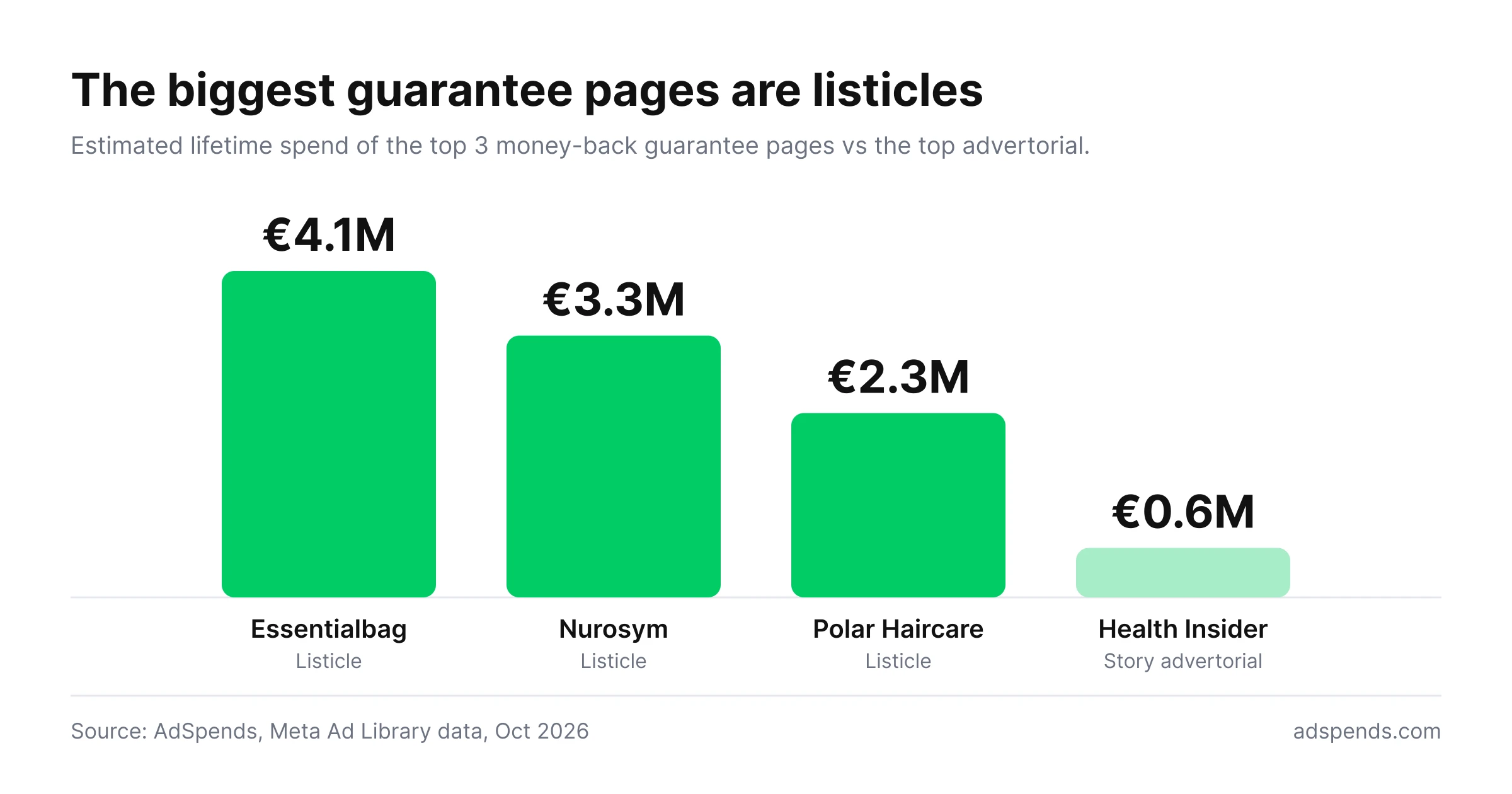






The 376 guarantee pages average about €56K each; the 537 advertorials average about €23K. Same offer, different format, more than double the budget per page. Listicles are cheaper to produce, easier to localise and easier to keep compliant, which is why they dominate the highest-spend end.
Editorial is a distribution purchase, not a writing one. Two of the top skincare pages in the set sit on real publications: a Daily Mail page at €153.1K and a BBC Good Food /advertisement-features/ page at €120.1K.




You are renting the masthead’s trust and its disclosure rules. Your copy has to be signed off by someone else’s legal team.
Length, byline, images: the formatting rules that hold in 2026
In short
- Length is set by beats, not by a word count target.
- A real byline, a date and a credential beat any amount of design polish.
- Label the page as advertising. Every time.
So how long should an advertorial be?
Length. The dataset does not measure word count, and no honest guide can hand you a number. Set length by the skeleton: a story advertorial needs room for a named narrator, four to six failed alternatives, a mechanism explained in a full paragraph, and a proof cluster. Cut anything that does not advance a beat. If one mechanism needs 3,000 words, you have two advertorials in one document.
Byline. An author byline and bio appear on 19% of the 537 advertorials and 38% of sleep and stress pages. A real name, a credential, a publication date and a review line are the cheapest credibility you can buy, and most of the market skips them.
Images. One hero image that shows the outcome, then one per beat: the study screenshot, the product in use, the before-and-after, the guarantee badge. An image that doesn’t carry an argument is a scroll risk.
Disclosure. An advertorial has to be identifiable as advertising. The clean pattern in the dataset: sponsored pages sit on an /advertisement-features/ path on the publisher’s own domain, and advertorial domains carry a standing commission and advertiser disclosure in the footer plus a pop-up on entry. Build the label into the template, not into the last-minute review.
Treat all of this as your advertorial template: six beats, one skeleton, four formatting rules, and a disclosure line you never remove.
When to cut it and when to scale it
In short
- Review at day 14, day 45 and day 127, the median run in the set.
- Cut on angle drift, a missing mechanism, or a single CTA.
- Scale by duplicating the page to a new awareness stage, not by inflating the budget on a page that never converted.
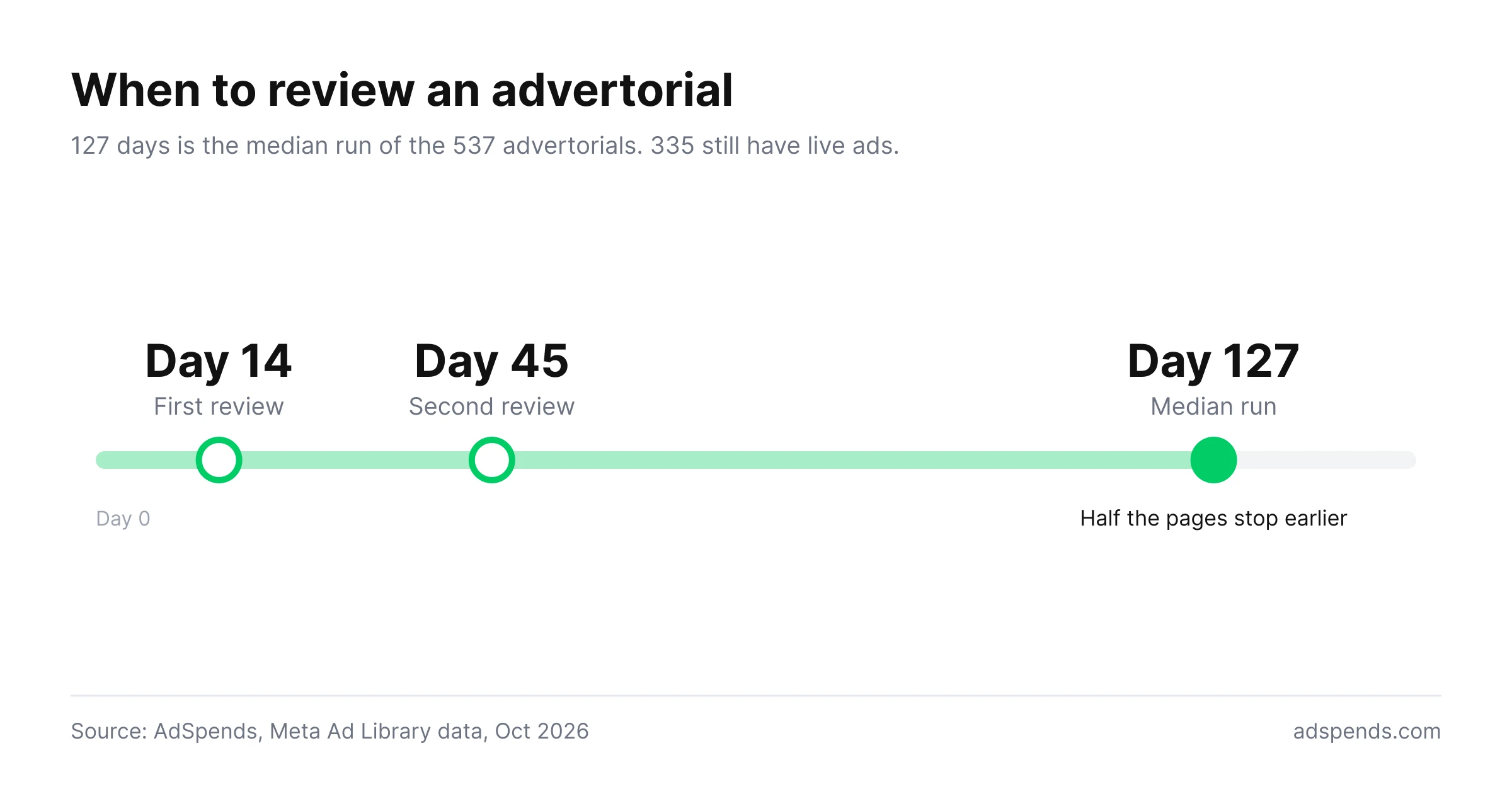
The dataset gives you a benchmark most teams never set: the median advertorial runs 127 days, and only 335 of 537 still have active ads. Half the market’s pages stop before the median. A page still carrying ads at day 127 is doing something right, and the cumulative spend on it is the closest thing to proof you can see from outside the account.
Cut rules
- The ad promises one angle and the page opens on another.
- The mechanism is not named by the first scroll, or it changes names halfway down.
- The page has one CTA in total, or the CTA asks for a purchase before the mechanism has landed.
- The offer on the page is weaker than the offer on the PDP.
Scale rules
- The page is still live past the median, and new ads are still being added to it. 35 new advertorial pages appeared in the last 30 days; watch which of them survive.
- The same mechanism can be re-skinned one stage up or down the ladder: an unaware version for cold prospecting, a product-aware version for retargeting.
- The angle can be cloned per avatar without rewriting the mechanism paragraph.
The advertorial copy checklist
Run every page against this list before a single euro goes behind it.
- One reader, one problem, one product on the page.
- Hook in the first 40 words: a person, a number, a stake.
- Problem block names the cost of doing nothing in the reader’s own language.
- Four to six failed alternatives named: the ones the reader has actually paid for.
- Mechanism named by the 400-word mark, explained in one repeatable sentence, identical on the PDP.
- Pivot names the solution category before the product appears.
- Proof cluster: testimonials with names, a customer count, one rating or citation.
- Offer stack: one discount, one guarantee with a stated length, one reason now.
- Three CTAs: after the mechanism, after the proof, after the FAQ.
- Byline, date and credential, plus a visible advertising label.
- Ad and page share the same angle, mechanism and hero image.
- Review scheduled at day 14, day 45 and day 127.
Frequently asked questions
What is an advertorial?
A landing page bought with paid distribution, written and laid out like a story, a news article or a first-person account, carrying one product and one call to action. Its job is to move a cold reader one awareness stage, so the product page does not have to diagnose and close at the same time.
What is the structure of an advertorial?
Six beats in reading order: hook, problem block, mechanism, pivot to the solution category, product and proof, offer and CTA. Each beat moves the reader one awareness stage.
How long should an advertorial be?
Long enough for the six beats and no longer. The AdSpends dataset does not measure word count, so set length by the skeleton: a named narrator, four to six failed alternatives, a mechanism explained in a full paragraph, and a proof cluster. If one mechanism needs 3,000 words, you have two advertorials.
What hooks do advertorials use most?
Across 537 live English advertorials: personal or case story on 39%, expert authority on 27%, pain point callout on 23%. These shares are within two points of all English direct-response pages. The angles underneath differ more: Hidden Root Cause on 66% and Failed Alternatives on 64%.
What proof should an advertorial include?
Customer testimonials appear on 83% of the 537 advertorials, a money-back guarantee on 66%, a percent discount on 52% and a customer or sales count on 45%. Use them as a stack: named testimonials, a count, a guarantee with a stated length, and one discount.
Should I write an advertorial or a listicle?
An advertorial when the reader needs the reframe (unaware or problem-aware). A listicle when the category is already understood and the reader is comparing. The top three money-back guarantee pages in the dataset are all listicles, at €4.1M, €3.3M and €2.3M in estimated spend.
How long do advertorials run?
The median advertorial in the dataset runs 127 days, and 335 of the 537 pages still had active ads in October 2026. Review a page at day 14, day 45 and day 127.
Do advertorials have to be labelled as ads?
Yes. An advertorial has to be identifiable as advertising. Sponsored pages on publisher domains sit on paths like /advertisement-features/, and advertorial domains carry an advertiser disclosure in the footer plus a pop-up on entry.
Can an advertorial really spend $100K a day?
The data cannot confirm any daily budget: AdSpends spend figures are lifetime estimates since a page was first seen. What it can confirm is survival. The top page in the set carried €617.5K in estimated spend across 1,931 ads over 396 days.
How is the ad spend in this guide estimated?
From the EU reach data Meta publishes in its Ad Library, at a €30 CPM, cumulative since each page was first seen. It is an estimate, not a reported budget. Real budgets can be higher or lower.
Sources
AdSpends dataset, as of October 2026. 537 English advertorial landing pages from 199 brands, €12.5M in estimated ad spend, 335 pages with active ads, median runtime 127 days. Spend is estimated as EU reach from the Meta Ad Library × €30 CPM, cumulative since each page was first seen: an estimate, not a reported budget. Pages are classified by AdSpends on format, hook, angle, offer, pain point and awareness stage, each classification backed by a quote from the page. Comparison baselines are all English direct-response pages in the same dataset (559 pages for hook and offer shares; 537 advertorials for niche shares).
- Advertorial landing pages: 537 pages, 199 brands, €12.5M
- Sleep and stress advertorials: 53 pages, 24 brands, €2.0M
- Skincare advertorials: 95 pages, 54 brands, €1.7M
- Curiosity gap headlines: 39 pages, 32 brands, €1.2M
- Money-back guarantee pages: 376 pages, 168 brands, €21.1M
- Brand-level ad and landing page records: Meta Ad Library brand profiles
- Eugene M. Schwartz, Breakthrough Advertising (1966): The five stages of awareness: unaware, problem-aware, solution-aware, product-aware, most-aware
- Meta Ad Library: The public ad archive, and the source of the EU reach data behind every spend estimate
- Health Insider, InnerFlo advertorial: Anatomy taken from the AdSpends record (October 2026)